A Stroll Through the Summer Palace: Beijing’s Imperial Masterpiece
As a travel blogger who loves helping international friends uncover the real China, I’m always on the lookout for places that are not just beautiful, but meaningful. And few places in Beijing pack as much history, art, and sheer grandeur into one visit as the Summer Palace.
Think of it as the ultimate imperial getaway. It’s where the emperors and empresses of the Qing Dynasty came to escape the summer heat of the Forbidden City. Today, it’s a UNESCO World Heritage Site and one of the most stunning examples of Chinese landscape design you’ll ever see.
Why It’s a Big Deal (According to UNESCO)
The Summer Palace isn’t just a pretty park. UNESCO describes it as “an outstanding expression of the creative art of Chinese landscape garden design” — a place where human-made structures and nature blend into perfect harmony. It has influenced garden design across all of Eastern Asia and stands as a powerful symbol of one of the world’s great civilizations.
A Quick Peek into Its Past
The palace was first built in 1750 during the Qing Dynasty, under Emperor Qianlong, and was originally called Qingyi Yuan (Garden of Clear Ripples). Unfortunately, it was destroyed by the Anglo-French allied forces in 1860.
Decades later, the Empress Dowager Cixi ordered its reconstruction and gave it the name Yihe Yuan — the Garden of Health and Harmony. In 1924, it finally opened to the public. So when you walk through its gates, you’re walking through more than 250 years of dramatic history.
What to See: The Absolute Musts
The Summer Palace is enormous — 297 hectares — with three main areas: the administrative zone, the imperial living quarters, and the scenic landscape zone. Here’s what you absolutely can’t miss:
- The Longevity Hill & Tower of Buddhist Incense
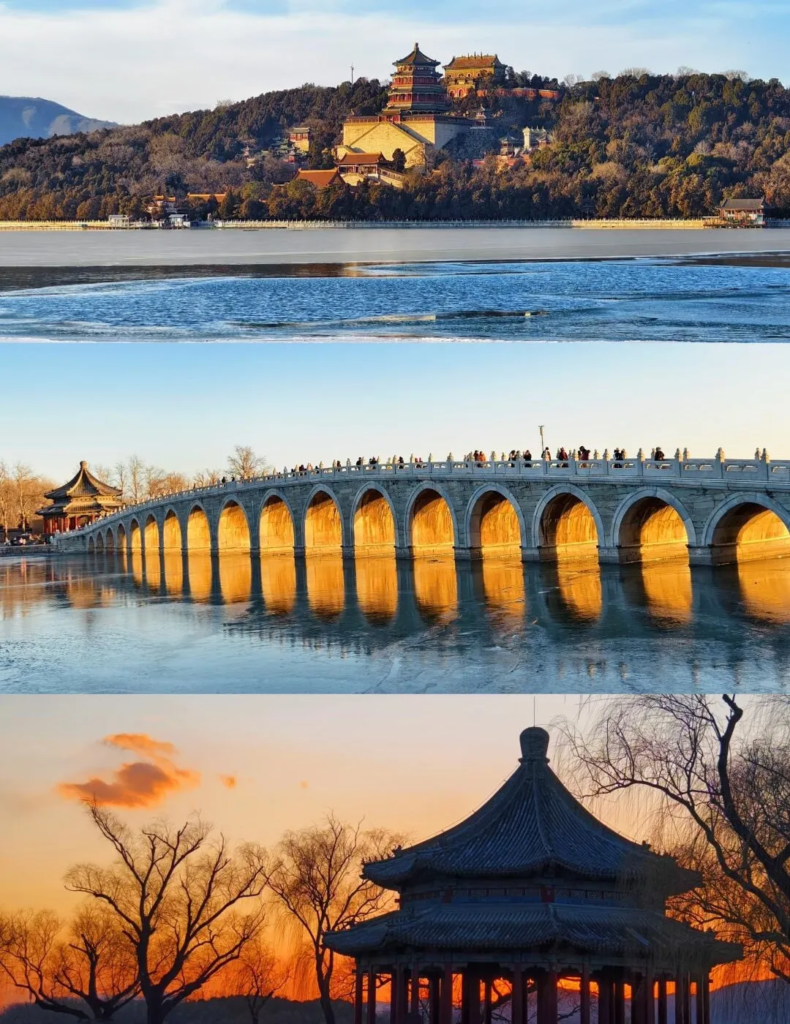
The Tower is the heart of the entire palace. Standing 41 meters tall on the front of Longevity Hill, it’s an eight-sided, four-eaved masterpiece. From the top, you get jaw-dropping views of Kunming Lake and the surrounding hills.
- The Seventeen-Arch Bridge
This iconic bridge spans the eastern side of Kunming Lake, connecting to South Lake Island. With 17 arches, it’s one of the longest imperial garden bridges in China. Don’t miss the bronze ox nearby — it was placed there as a mythical guardian against floods.
- The Long Corridor
728 meters long. Over 14,000 colorful paintings. This covered walkway is the longest of its kind in any Chinese garden. As you stroll, look up — you’ll see scenes from Chinese literature, folklore, and mythology. It’s an open-air art gallery and a shady escape on a hot day.
- The Marble Boat (Qing Yan Fang)
Half boat, half pavilion, this curious structure sits in the northwest part of the lake. It was built to be solid — a symbol of stability. But it’s also a reminder that no political power lasts forever, no matter how grand the symbol.
How to Get There
- Subway : Line 4 to Xiyuan Station, Exit C2. Walk about 10 minutes to the East Palace Gate.
- Bus : Lines 330, 331, 332, 346, 394 to Yiheyuan Station (East Gate).
A Few Personal Notes
Bring water and comfortable shoes. You’ll walk a lot. If you have time, rent a small boat on Kunming Lake — seeing the palace from the water gives you a whole new perspective. And don’t skip the back hills: fewer tourists, great views.
The Summer Palace is not just a museum of old buildings. It’s a living, breathing place where Beijingers still come to fly kites, sing opera, dance, and drink tea. That’s the real magic — you’re not just seeing history. You’re watching a culture continue to live inside it.
Have you been to the Summer Palace? Or are you planning a trip? Let me know in the comments — I'd love to hear your thoughts or help you plan!